The AI Robot Association, a Japanese non-profit chaired by Waseda University professor Tetsuya Ogata, has unveiled AIRoA-0, a foundation model for robot learning.
The model was trained on 16,151 hours of manipulation data collected with YUBI, a handheld gripper device that records video and fingertip trajectories while a person works. The association said the model learned without teleoperation, reinforcement learning or corrections on a real robot, using only data gathered as people carried out tasks directly.
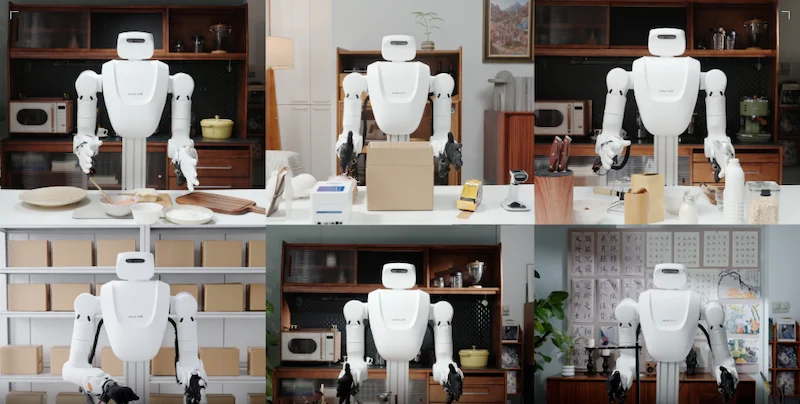
Tested in environments different from where the training data was collected, the model performed two-armed tasks such as sorting small parts and folding towels, with an average success rate of 78 per cent. Four representative models fine-tuned on the same data reached a best success rate of 27 per cent. The team also verified that the model copes when a person moves objects mid-task and that it works across different robots.
AIRoA-0 was developed using the weights of Physical Intelligence's pi-0.5 base model. The association has released the code for researchers and developers, and the paper, titled AIRoA-0: Long-Horizon, Precise, Cross-Embodiment Manipulation from Handheld Data, is on arXiv.
Background
AI Robot Association
Robotics association
The AI Robot Association is a Japanese non-profit organisation set up to combine artificial intelligence and robotics and to widen the use of robots across society.
Description from iRobotNews
AIRoA-0
Robot foundation model
AIRoA-0 is a robot foundation model trained on manipulation data collected with the handheld YUBI device.
Description from iRobotNews
YUBI
Data collection device
YUBI is a gripper device a person holds while working, recording video and fingertip trajectories for robot training.
Description from iRobotNews