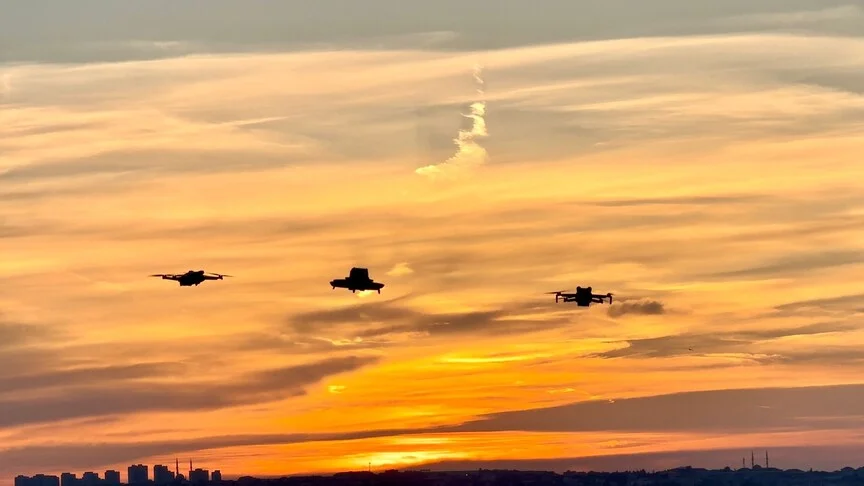
A number of Russian enterprises in the energy, transport, and industrial sectors have announced tenders to procure machine gun turrets for protection against drones, Sibir.Realii reported. Russian businesses were permitted to purchase weaponry for anti-drone defense at the end of May 2026, with the authorized list including turrets, anti-aircraft artillery, and electronic warfare systems.
Among the purchasers, the Ust-Luga Directorate of the North-Western Basin Branch of FSUE "Rosmorport", which handles security for the port of Ust-Luga in the Leningrad region, decided to acquire three machine gun mounts equipped with thermal imaging sights and monitors for 8.9 million rubles. The seaport has repeatedly been subjected to drone strikes, most recently on September 1. It is the largest Russian port on the Baltic Sea and the second largest in the country, having handled exports of 700 thousand barrels of oil per day in 2025.
JSC "Airport Surgut" posted a 909 thousand ruble tender to acquire a turret for two twin machine guns, specifying that the mount must feature a thermal imaging sight, a remote control monitor, and an external uninterruptible power supply. Surgut is located approx. 2500 from the border with Ukraine, where Armed Forces of Ukraine drones struck a facility within city limits on October 16 for the first time since the start of the war, hitting the Chernomyrdin Surgut Condensate Stabilization Plant owned by "Gazprom pererabotka".
Additionally, PJSC "Kolymaenergo" bought a turret for a Degtyaryov light machine gun to be operated by mobile fire group personnel at a site in the settlement of Sinegorye, Yagodninsky District, Magadan Oblast, the location of the Kolyma Hydroelectric Power Station. In November, the Angarsk Electrolysis Chemical Combine, part of Rosatom, also announced a tender to purchase a turret. These facilities have not yet been targeted by attacks.
The procurement efforts follow an August decree signed by Russian President Vladimir Putin, enacted after the Armed Forces of Ukraine intensified attacks, allowing the state to take over facilities whose owners fail to protect them from drones and other threats or fail to carry out restoration work following strikes. The decree applies to fuel and energy complex, industrial, municipal, transport, and logistics infrastructure. In October, Alexander Shokhin, head of the Russian Union of Industrialists and Entrepreneurs, complained that it is impossible to provide air defense coverage across all large enterprises because they occupy too large an area.