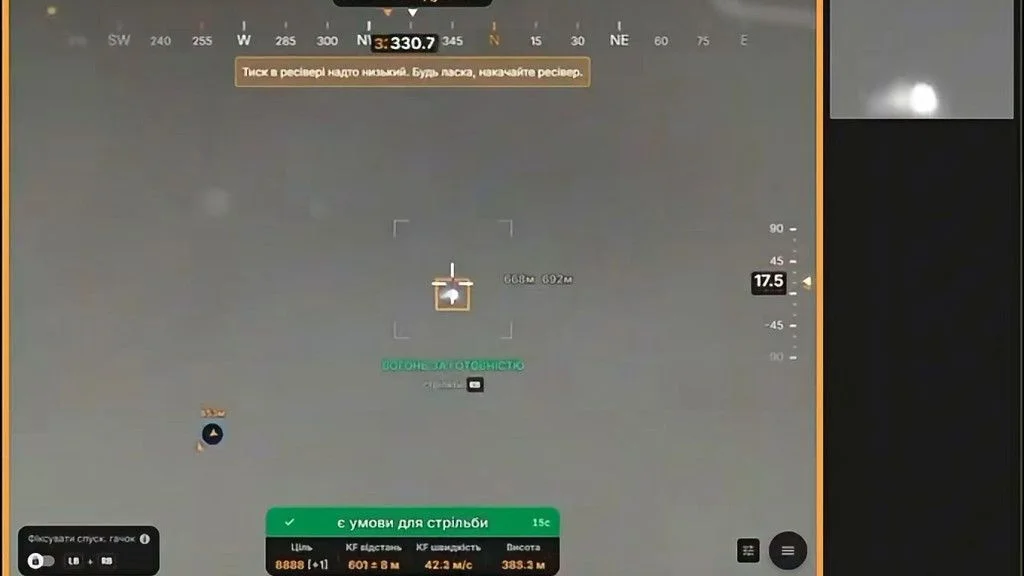
Anatolii Khrapchynskyi, a Ukrainian aviation expert and reserve officer of the Ukrainian Air Force, told Deutsche Welle that getting laser systems such as Blysk to work reliably could cut the cost of each shot sharply and stop Ukraine spending scarce, expensive missiles on mass drone attacks. Presidential adviser Serhii Beskrestnov said on 25 November that Blysk, developed and operated by Carmine Sky, had shot down a Russian jet-powered Geran drone.
Khrapchynskyi said a jet-powered Geran flies at 450 to 550 km/h, or 125 to 150 metres a second, which leaves a laser six to eight seconds at a distance of one kilometre. Allowing a second to steady the beam on the target and three to four seconds to burn through it at 4 kW, a system has in effect one guaranteed attempt at one fast target, he said, so during mass attacks lasers must work in networks or alongside other air defences.
According to the experts DW spoke to, a laser does not always have to destroy its target: it can blind the cameras of reconnaissance drones and the seekers of munitions, which conventional electronic warfare cannot stop. Weather matters, though, and in bad conditions most of the work would fall to anti-aircraft guns, missiles and interceptor drones.
Blysk was built within the government's Private Air Defence programme with support from the Brave1 defence technology cluster. Several Ukrainian companies are working on air defence lasers, Beskrestnov said, the best known earlier one being Celebra Tech's Tryzub. He said it is too early to talk about mass production because laser technology is very complex and expensive, and the experts note that Ukraine does not make fibre lasers itself.
Background
Carmine Sky
Defence company
Ukrainian defence company working on infrastructure and technology to strengthen Ukraine's defence.
More stories about Carmine Sky
Anatolii Khrapchynskyi
Aviation expert
Ukrainian aviation expert and reserve officer of the Ukrainian Air Force.