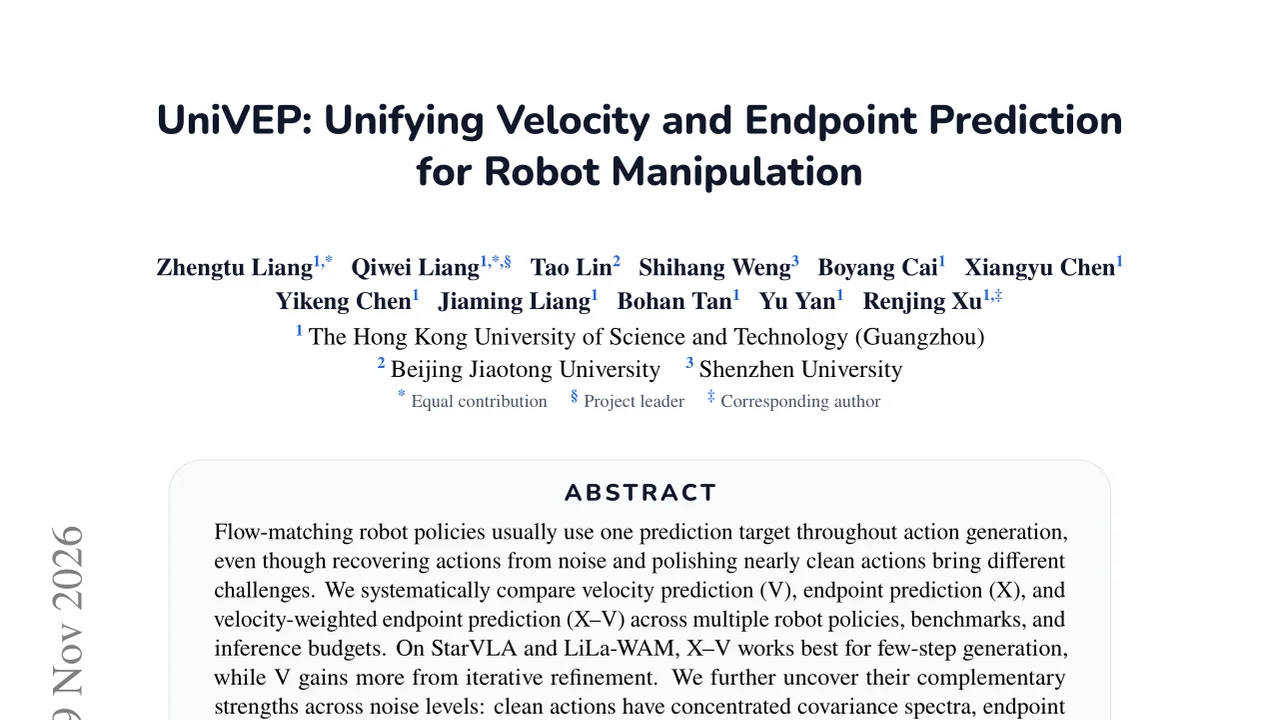
A team from University College London, the Hong Kong University of Science and Technology (Guangzhou) and several partner institutions has built an agent that plans scientific experiments and carries them out with a robotic system. In a paper posted on arXiv, they describe how their Embodied Science Agent ran wastewater treatment experiments that remove dye.
A digital agent uses scientific data, records of earlier experiments and Bayesian optimisation to choose what to test next. An embodied agent controls the instruments, and an interface coordinates the two. The agent chose conditions from more than 200 million possible combinations and used each result to guide the next test.
Over 15 consecutive rounds, the authors write, it raised the final solution transmittance from 82% to 99.7%, which corresponds to a 98.5% reduction in residual dye. In a separate test it handled an electrode rack placed in different positions. The tests measured decolourisation only, which does not by itself show that the dye broke down completely or that other pollutants were removed.
Background
Embodied Science Agent
AI research agent
An AI agent that plans scientific experiments and carries them out with a robotic system.
Hong Kong University of Science and Technology (Guangzhou)
University
A university run jointly by mainland China and Hong Kong, in the Nansha district of Guangzhou.