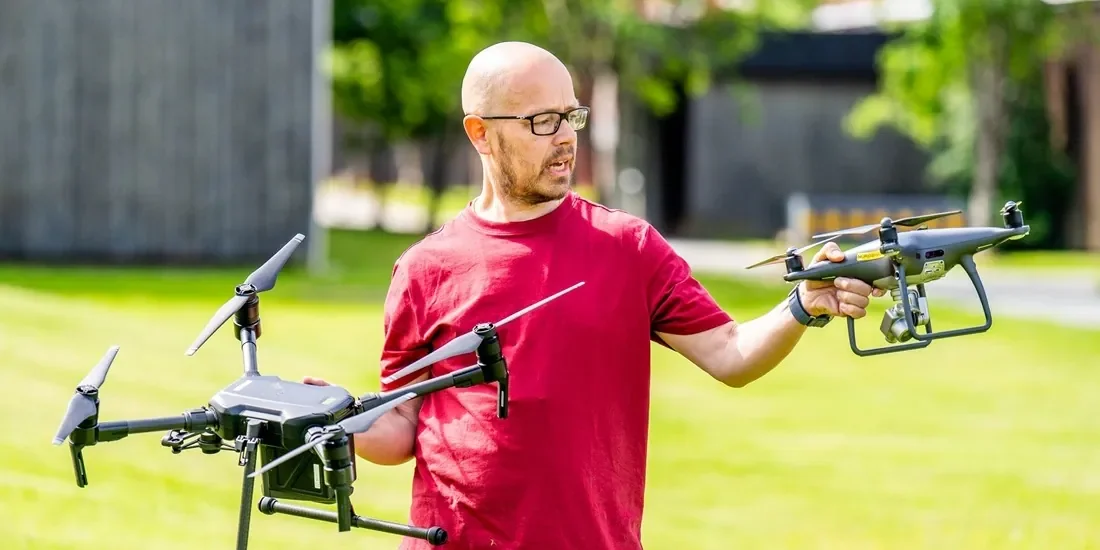
Researchers at the Autonomous Robots Lab of NTNU, the Norwegian University of Science and Technology, working with ETH Zurich, have built a quadcopter that uses contact with obstacles to change its shape for a moment and fly through openings much narrower than itself, DronEzine reported.
Its two side arms have elastic joints made of two toothed cams held together by springs, which roll on each other without slipping. The arms fold back when they hit an obstacle and return to their normal position once through, with no motors, servos or other actuators for the folding. The team tuned 22 parameters of the drone's geometry and joints in simulated flights through gaps of 15 to 25 cm.
The prototype is 31.3 cm wide in normal flight and can narrow to 14.1 cm, so it passes gaps 52% narrower than itself, against about 29% for earlier folding-arm designs, according to the researchers. It flew at 2 metres a second through a 15 by 20 cm opening, tilting to 94 degrees and losing 56 cm of height before hovering again, and it also passed through a tube 22.5 cm across. Approaches up to 30 degrees off line worked, but at 35 to 40 degrees the impacts sometimes dislodged an arm.
Background
Norwegian University of Science and Technology
University
The Norwegian University of Science and Technology (NTNU) is a Norwegian university with campuses in Trondheim, Gjøvik and Ålesund.
More stories about Norwegian University of Science and Technology
ETH Zurich
Research organization
Public university in Zurich, Switzerland, founded by the Swiss federal government in 1854, which teaches and researches mainly science and technology.