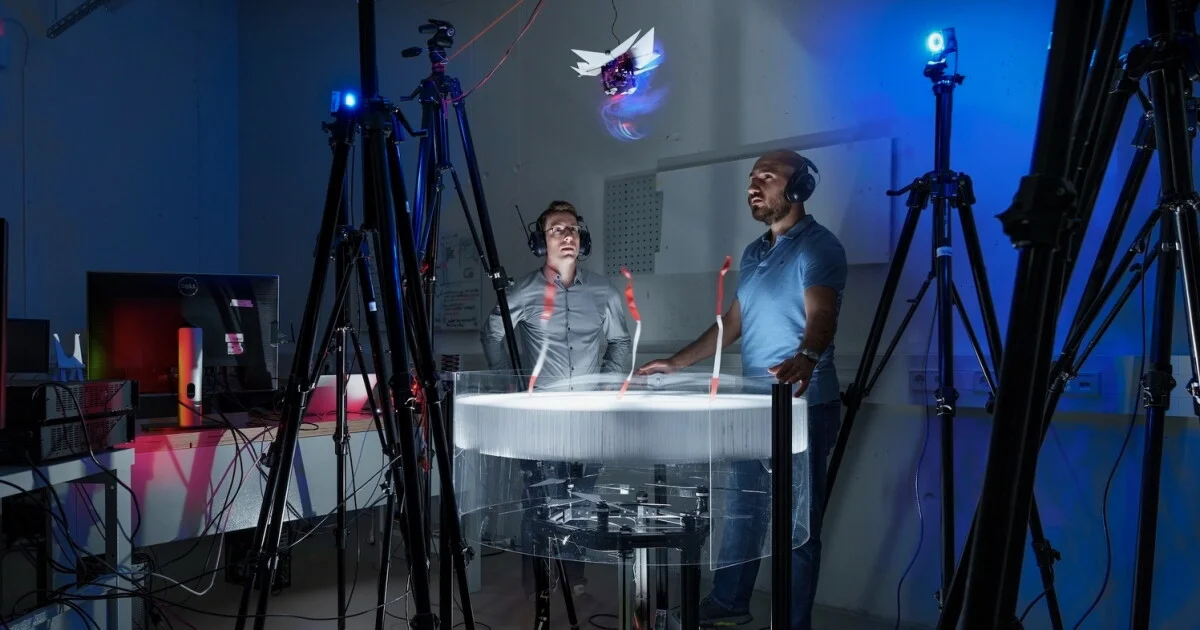
A team from the Institute of Intelligent Systems and Robotics (ISIR) at Sorbonne University, working with the University of Tokyo and other institutions, has shown a way for swarms of tiny robots to recognise the shape of the space they are in without a map. The work is published in Science Robotics.
In the method, called spectral swarm robotics, each robot holds a number that works like a virtual temperature and swaps it with nearby robots. How quickly the differences fade depends on the network of connections, which reflects the shape of the space. Each robot uses this to estimate a numerical signature of the shape and compares it with known shapes, using only short messages and simple calculations.
The team ran simulations with up to several hundred robots and seven arena shapes, then tested two types of robot. Kilobots identified the right shape in 22 of 30 trials, and a group of 25 Pogobots told a disk-shaped arena from a ring-shaped one in all 30 trials.
First author Leo Cazenille said the team next wants the robots to keep moving while they estimate the shape.
Background
Sorbonne University
University
A French university whose Institute of Intelligent Systems and Robotics (ISIR) worked on spectral swarm robotics.