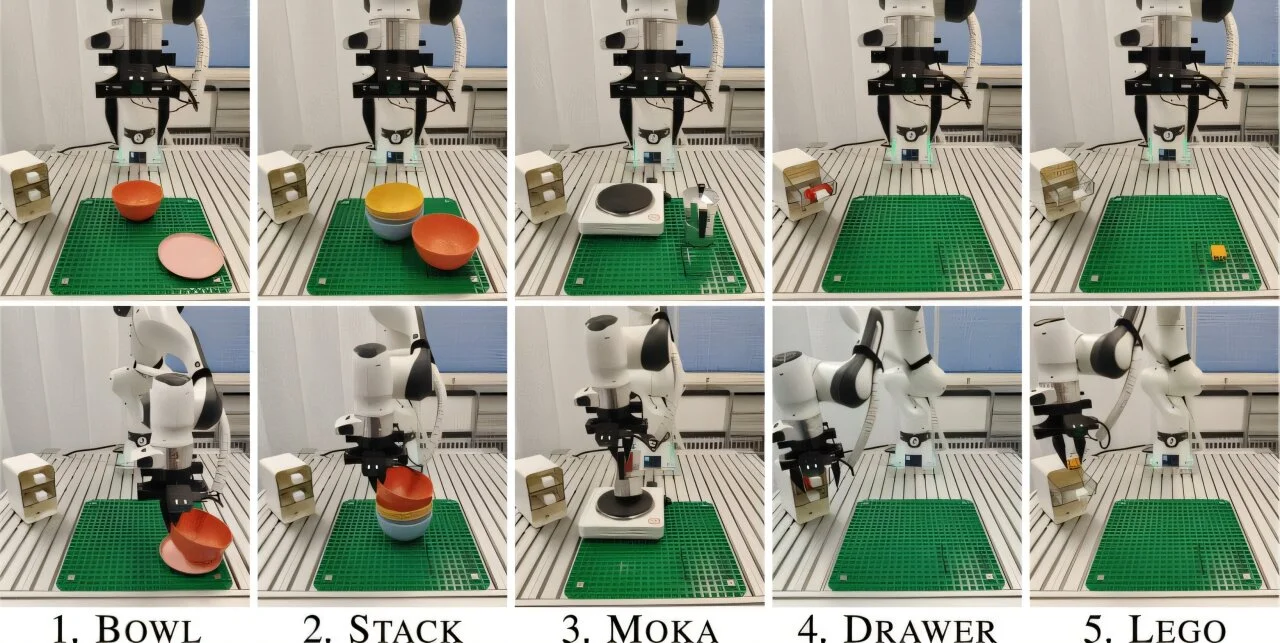
Sunli Chen and six co-authors present TRIP, a way for an AI agent that controls a robot to set its own interrupts, in a paper on arXiv. When an agent hands a task to a pretrained robot policy, it usually cannot step in again until the call returns, even if a person walks into the robot's path or moves the object it is about to grasp.
With TRIP, the agent writes a tripwire with each call: a small Python program that runs next to the policy, can ask a compact vision-language model, for example where a person is and how far away, and decides whether to stop the policy and hand control back with the reason. The agent then reassesses and continues under a new tripwire. The method needs no training.
On RoboHD, a benchmark of 168 simulated scenes in which a person disturbs the robot and any contact counts as failure, TRIP cut contact with people by half when paired with the best policy, so that safety rose from 61.3% to 81.3%, while task success was 38.7% against 31.0% for a turn-based harness. In real-robot experiments it completed two manipulation tasks under human interference where the alternatives largely failed.
Background
Sunli Chen
Robotics researcher
Sunli Chen is a PhD student in computer science at the University of Massachusetts Amherst who works on embodied AI and large language models.