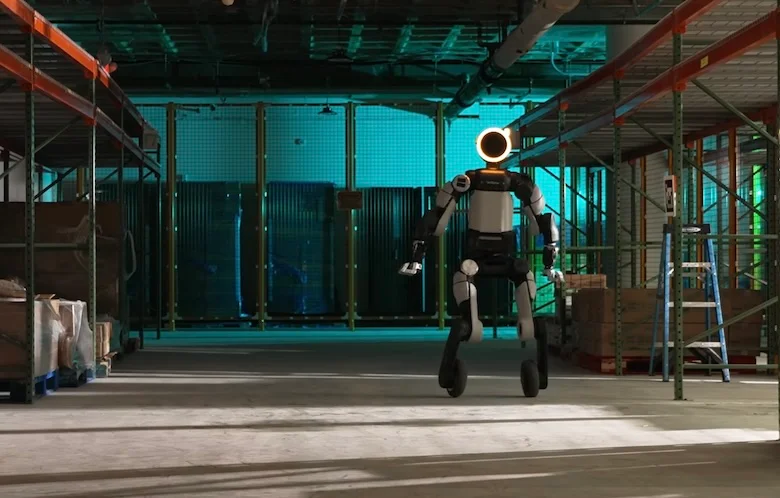
Nico Bohlinger and Jan Peters have described STRIDE in an arXiv paper, a way for humanoid robots to learn to walk directly on the robot from minutes of data. Usual walking rewards track the robot's body speed, which cannot be measured on board without motion capture or a well-calibrated estimator, so STRIDE instead rewards the robot for following a commanded acceleration, measured by its inertial measurement unit.
Using the XQC reinforcement learning algorithm with stiff joint control and left-right mirroring of data, STRIDE learned to walk on Unitree G1 and Booster T1 humanoids in simulation within 14 minutes of samples. The two additions cut falls during training by 81%; without them, learning took more than an hour, the authors report.
Background
STRIDE
Humanoid walking method
A method that lets humanoid robots learn to walk from minutes of data, using only their onboard motion sensor for the reward.
Description from arXiv Robotics (cs.RO)
Unitree G1
Product
Unitree humanoid robot, about 127 cm tall and about 35 kg.
Description from unitree.com